‘Like Natalia Goncharova, many of us consider ourselves ‘everythingists': centaurs: human animals dancing with our machine shadows’ -Es Devlin
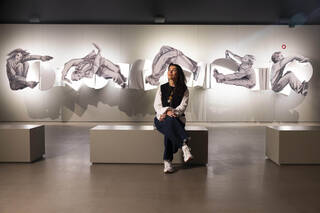
Commissioned to respond to Natalia Goncharova's 1926 painted backcloth for the Ballets Russes production of The Firebird, artist Es Devlin has drawn and painted this shadow dance within the movements of east London based dancer Joshua Shanny-Wynter, suspended between enlarged iPhone boxes that echo the architecture of Igor Stravinsky’s
The Firebird score and V&A East Storehouse storage crates. Over a soundtrack by Polyphonia, rooted in
The Firebird’s horn theme, Devlin reads Natalia Goncharova’s techno-optimistic 1913 manifesto, Cory Doctorow’s 2026 reflections on centaurs and reverse centaurs in animatronics, the 1958 poem
Centaur by Clark Ashton Smith, and Adrienne Rich’s 1971 poem
Centaur’s Requiem.
The term ‘everythingism’ was used to describe Goncharova’s painting, theatre design and performance art. It can also be applied to Devlin’s own practice encompassing sculpture, music, performance design, poetry and painting
Goncharova’s 15m wide painted backdrop was made for Diaghilev’s 1926 production of The Firebird, choreographed by Mikhail Fokine and composed by Igor Stravinsky in 1910. Wynter’s movements were choreographed by East London based choreographer Botis Seva. Every 90 seconds the artwork is animated by illumination and underscored by Devlin’s voice reading a series of texts over a soundtrack composed by Polyphonia. Stravinsky's horn theme was conceived to signify the lifting of the sorcerer Koschei’s curse, the return of light and life, transcendence after chaos. It was based on a traditional folk song found in a collection by Nikolai Rimsky Korsakov.
LOCATION AND DATE: London 2025–26
MATERIALS AND TECHNIQUES: Painted and printed plywood, sound
Fabrication by Scena
Sound by Polyphonia
With special thanks to the V&A East Collective Community for their generous feedback