
Theatre and Performance Collection volunteer, Suzy Quinn, shares her unique experience of cataloguing the June Whitfield Archive.
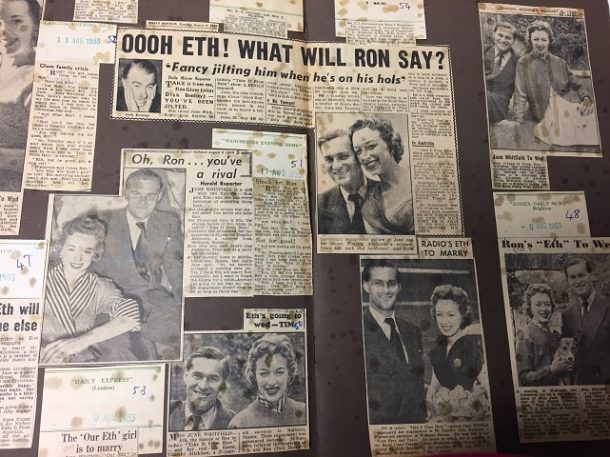
“That’s a lovely collection of engagement photos of Mum and Dad”, I thought as I went through one of the many scrapbooks belonging to my mother, the actress June Whitfield. These had been recently accessioned as part of her archive by the Department of Theatre and Performance department. For the last few months, I have been enjoying the experience of working in the Theatre and Performance Archive at Blythe House, cataloguing my mother’s archive. When Simon Sladen, Senior Curator in the department confirmed that my mother’s collection would be added to the V&A collection, I cheekily asked him if I could ‘shadow’ him to follow the journey of my mother’s ‘stuff’ as I am currently studying for an MA in Museum and Gallery Studies. To then find myself taken on as a volunteer and given the job of actually sorting through my mother’s documents to box and catalogue them, is a tremendous privilege, but also a unique experience for both the V&A and myself. There can’t be many daughters working on cataloguing their mother’s archive in a museum can there?
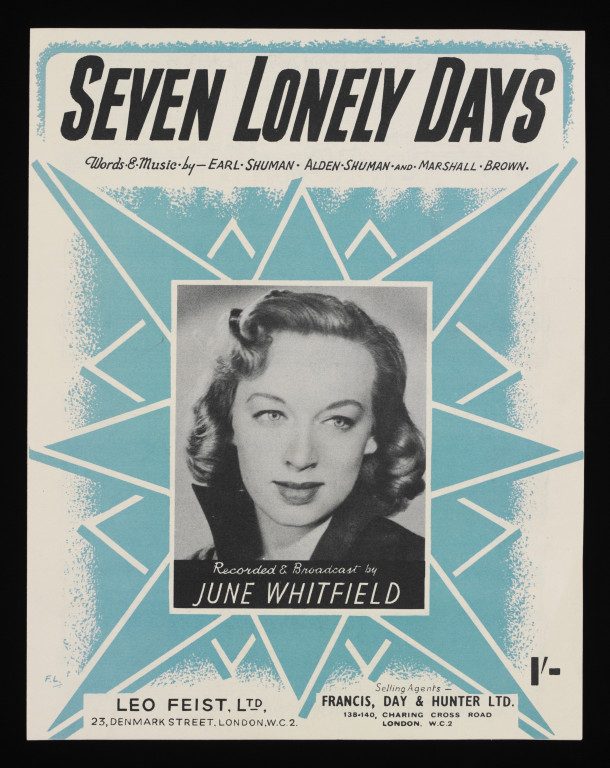
The plus points of being so close to the information I am sorting through are many. For example, I have direct access to the ‘primary source’ – namely my mother – should I need clarification over a document. Furthermore, I was there when much of the later information was collected. Therefore, the amount of research I have had to do on information in the archive post 1960 is minimal, as I remember it or at least have a memory of it. How lucky am I to be able to pick up the phone to my mother to confirm that memory? An instance of this occurred when I found a black & white photocopy of a headshot of Marion Davies, an early twentieth century musical comedy star. Attached to the headshot was a sample of red hair. I was intrigued. What was the significance of this document? I had discovered it amongst information about my mother’s appearance as Madame Dilly in the 2005 ENO production of ‘On the Town’. A memory of my mother in a red wig prompted me to call her and confer. As I suspected, the document was research for a wig style and hair colour for the character of Madame Dilly. Chatting with Sabrina Offord, Archivist and Conservation Manager for the Department of Theatre and Performance, I discovered that had I not been able to supply the knowledge about the headshot and hair, the significance of this document might well have been missed. So solving the mystery of the relevance to the archive of the headshot of Marion Davies was proof of how useful it can be to have a daughter working on her mother’s archive.
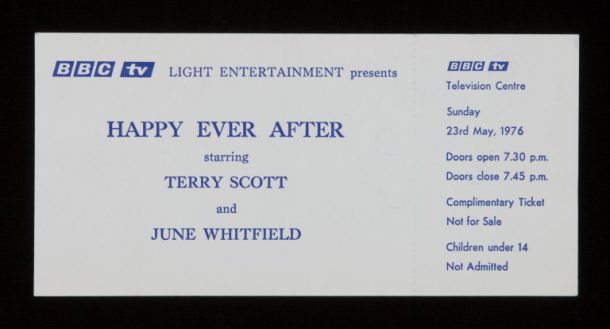
However, as I work I also have to remember that my input into my mother’s archive must be as objective as possible. With this in mind, I have resisted the temptation to re-organise some of her later filing that wasn’t quite as systematic as her earlier endeavours (no doubt due to the fact there were more demands on her time once she was married with a daughter – me!). One principle of archival practice is to maintain the original order of documents as much as possible, which I follow, even though I know if the later files were still at home my mother would be happy for me to re-organise them. Strange to think that before that morning when Simon came to collect the scrapbooks, scripts and correspondence that form the bulk of my mother’s collection, a cup of coffee could have been spilt on a script, or a page accidentally ripped and there would have been no dire consequences. But with the legal paperwork complete and the archive donated to the V&A, no coffee is allowed near these now precious documents being preserved for the nation, whilst every care is taken to keep the pages intact. Stranger still to me is the fact that in future, should I want to browse through any aspect of the June Whitfield Archive, I will have to make an appointment like any researcher to view the material in the Reading Room.
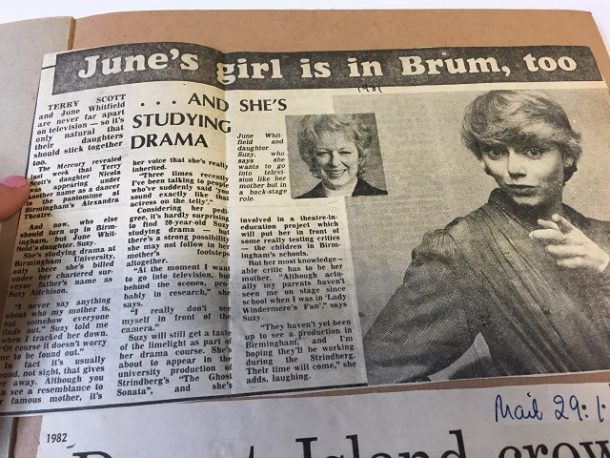
Another oddity for me and I’m sure for my colleagues as well, is that not only can I provide an ‘I was there’ context to much of the later information contained in the archive, but I am also part of the archive. In her scrapbooks my mother tended to mix the professional and the personal, hence the press clippings surrounding my parent’s engagement. Later scrapbook pages reveal assorted pictures of me at various ages, some with truly dreadful haircuts and outfits that I remember so well.
There are documents that resonate in the memory too, such as the programme for a Birthday Fair my mother opened at a local school in 1968, a school which I later attended. I remembered that my parents were looking for a suitable school for me at the time my mother opened the Fair, and The Study obviously filled their criteria. Seeing the programme and the accompanying correspondence, childhood memories flooded back, including the fact that my mother had opened the Fair, which I had completely forgotten.
I discovered another school connection when I was trawling through some notes my mother had made on a radio series in which she was taking part. I found a reference to a school quiz that had to be completed by Study pupils every Easter holiday. ‘Fair Deal’ a radio panel game, was centred around general knowledge of various topics. My mother obviously saw an opportunity to glean some useful answers for the quiz and I remember returning to school with answers that no one else had found, thanks to the brilliance of Ian Masters who devised ‘Fair Deal’ and who was extremely knowledgeable of even the most obscure facts. I think most parents ‘helped’ their children with the Easter quiz, answers being obtained by fair means or foul!
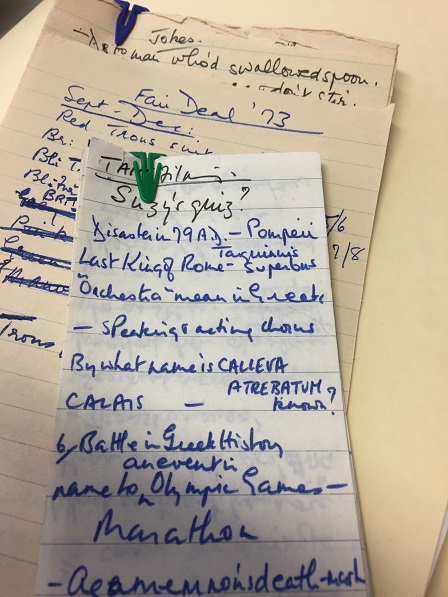
As I continue to examine my mother’s documents, I am discovering information about her and my family of which I was unaware or had forgotten. It is thanks to all the kind folk at the V&A, in accepting me as part of their volunteering team, that I am making these discoveries, which are emerging as a by-product of the cataloguing process. To have been given the opportunity to explore and sort these documents with the purpose of them becoming part of the Theatre and Performance archive, is an amazing experience in itself and one for which I am extremely grateful. Add to that the fact the documents are part of my family history, and I consider myself to be one very lucky actress’s daughter.
Dame June Whitfield will be appearing in conversation at the V&A Museum on Monday 22nd January.
In February 2018, Stand Up at the V&A will celebrate the centenary of women’s suffrage. The full line up and tickets are available on the V&A website.
More information about the June Whitfield Archive can be found on Search the Archives.
Thank you
Thanks to its simple yet effective gameplay, redactle is well-received by review sites as a puzzle game that both novices and puzzle veterans can enjoy.
Amazing archive journey feels like exploring secrets of 99 nights in the forest, rich and personal.
It’s fascinating to hear about Suzy Quinn’s personal journey cataloguing her mother’s archive at the V&A. The idea of stumbling upon “engagement photos” while processing a professional theatrical collection must have been a surreal and touching moment. It really highlights how personal history and professional legacy intertwine within such archives. I’ve been exploring similar themes of personal digital archiving and how to best preserve memories for the future and have found tools like OrbitDash to be quite helpful in managing and presenting various types of content. It makes me wonder how much of our own everyday lives, like those scrapbooks, will eventually become historical documents.
It’s fascinating to read about Suzy Quinn’s personal connection to cataloging her mother’s archive. The idea of encountering “engagement photos of Mum and Dad” within the professional context of a museum collection must have been incredibly poignant. It highlights how personal histories intersect with broader cultural narratives. This reminds me of the research we do at AI Interior Lab, where we often find that even seemingly mundane personal items can hold significant historical or design insights when viewed through a specific lens. I wonder if any particular item in the June Whitfield archive sparked a surprising revelation for Suzy beyond those initial family photos.
The personal perspective on cataloguing the June Whitfield Archive is fascinating, especially the moment of realizing the engagement photos were of her parents. It truly highlights how personal history becomes public artifact. It’s wonderful that the V&A is preserving such collections. I’ve been documenting my own personal journey with archiving and collections on Horizon 6 Guide, and it always strikes me how much meaning can be found in seemingly ordinary objects when viewed through a historical lens. It must be a profound experience for Suzy to be so directly involved in processing her mother’s legacy.
It’s fascinating to read about your personal journey cataloguing your mother’s archive at the V&A. The idea of encountering those engagement photos amidst professional documents must have been quite a poignant moment. You mention the unique experience for both the V&A and yourself, and I can only imagine how profound that must be, seeing a family history woven into a museum’s collection. It makes me think about how personal objects can hold such immense historical and emotional weight. I’ve been tracking similar personal artifact nuances regarding unique in-game items and their lore, which you can sometimes find on sites like Pokopia Crystals – it’s a different kind of archive, but the sentiment of preserving and understanding individual pieces feels quite connected.
It’s fascinating to hear about your personal journey cataloguing your mother’s archive. The idea of encountering those engagement photos within a scrapbook, amidst professional documents, must have been quite a poignant moment. It really highlights how personal history intersects with public legacy. You mention it’s a “unique experience for both the V&A and myself” – I can only imagine. It sounds like a deeply rewarding, albeit potentially overwhelming, project. I’ve been exploring similar archival processes for my own passion project, and I wrote about a similar approach on Borderlands 4 toolkit and found that the sheer volume of material can be the biggest hurdle, even when it’s deeply personal. It’s wonderful that June Whitfield’s contributions are being preserved so thoughtfully.
It’s fascinating to read about your personal journey cataloguing your mother’s archive. The detail about discovering the engagement photos in the scrapbook really highlights how personal and intimate these collections can be, even when they become part of a major public institution. I can only imagine the mix of emotions and the unique perspective that brings to the cataloguing process. It sounds like a truly special opportunity to connect with your mother’s legacy in such a hands-on way. I’ve always been interested in how personal histories get preserved and presented in museums; I wrote about a similar approach on KCD2Quest and found it a rewarding challenge to organize and contextualize information for players. Your experience with the June Whitfield archive must be incredibly fulfilling.
It’s fascinating to read about the process of cataloging the June Whitfield Archive from such a personal perspective. The idea of looking at your mother’s engagement photos within a scrapbook, and then knowing it’s becoming part of a museum collection, must be incredibly layered. I can imagine how that must feel, especially while you’re studying museum and gallery studies yourself. It’s a brilliant way to connect academic learning with real-world practice.
This reminds me a bit of the meticulous detail required when organizing information for something like a game guide. I’ve been working on compiling a comprehensive index for KCD2Quest, and the challenge of categorizing and cross-referencing everything so it’s easily accessible feels similar, though on a very different scale! It’s a testament to the V&A’s work that they can give such personal archives a structured home.
The idea of a personal scrapbook turning into a museum archive is fascinating, and I can only imagine how surreal that must feel, especially when it’s your mother’s! It’s wonderful that the V&A is preserving such personal items alongside the more public career aspects. I’ve always been curious about the behind-the-scenes work in museums. I wrote about a similar approach to cataloging and preserving unique historical artifacts on MW4 Hub and found that the personal stories embedded within the objects are often the most compelling. It sounds like an incredibly rewarding, albeit emotional, experience for you to be so directly involved with your mother’s legacy.
It’s fascinating to read about your personal journey cataloging your mother’s archive. The idea of stumbling upon engagement photos and realizing their archival significance must have been quite a moment! It really highlights how personal items can gain a new layer of meaning within a museum context. I wrote about a similar approach to managing personal collections and their integration into larger archival systems on Spire ESS and found that the intersection of personal history and institutional preservation is where some of the most compelling stories emerge. Your unique position as both daughter and cataloguer offers such a rich perspective on June Whitfield’s life and career.